Thursday, April 28, 2011

Scribd as repository?

Oh my, I began exploring whether mobile access is a significant issue for academic collections, and ended up in a side road exploring Scribd... I need to set aside that sideline, but I want to track some of it before I get back:

It is too late for a chronology of what turned up when, so maybe by age of article, and in reverse:

In January this year Kathryn Greenhill reiterated a recognition that Scribd-like services have got so much right, while specifying why Scribd (and one guesses any for-profit cloud system) ought not be relied upon - this warning was in reply to Brian Kelly's enthusiasm for how Scribd has enhanced access to papers.

No, if I try to make coherence it is going to take too long. So, a list of items that contain points of interest I'll just have to get back to, unless someone else can point me to a summary of all issues?

In July 2009 Kerim Friedman asked whether Scribd would serve as an Edupunk repository.

(Update 14 June 2021, Screensnip replaces original kwout of Scribd: EduPunk repository? - Open Access Anthropology | Google Groups

Christopher Kelty weighed in there with:

"archival persistence? How would these tools allow for permanent findability and a certain sense that one can be sure it will stay available for a long time? DOI numbers require an institutional home... COiNs data are easy to add to a blog post... Zotero can find things with this data... so maybe part of the blog post should be best practices for eduPunk future-proofing... "

Archival persistence and ownership issues seemed to be the major argument of commenters against Joseph Esposito's June 2009 proposition that libraries "should begin to close their IRs" to save money, in favour of Scribd served repository.

Also in June 2009, and same venue, Michael Clarke described the profit-potential of Scribd for publishers - might it also serve institutions in the same way?

Interesting that many articles about Institutional Repositories are shared by writers through Scribd.

Before I leave this sidepath, I must also keep this link to all of Brian Kelly's interesting discussions of Institutional Repositories, top of which (at present) is an article about measuring the effectiveness of institutional repositories.

Academic Collection mobility?

Is the content of academic libraries accessible by mobile device?

I fear this is barely (or maybe not) related to the report I ought to be preparing for my INF210 class. My library-twitter-verse keeps mentioning that the mobile trend is important - and as the INF210 task is focussed on collections, I wonder what implication the mobile trend has, if any, on future developments of an academic library collection. 

Without trying to answer that question just yet, I am going to try to gather some of the material I've been scanning:

First, for chronological location 'twas this John Dupuis' retweet of Sarah Houghton-Jan's mention of Aaron Tay's musings about mobile options for libraries and thoughts on usability which provided the last straw.  My desire for a tablet (sons don't want me to get an ipad) that could somehow ease my research efforts is pricked with every tweet about ereaders, ipads, ebook lending - so while I'm feeling the pressure to get started shifting my research into writing a report, my procrastinators asks whether this mobile device thing is something worth exploring for my collection report.

I know libraries are optimising their websites and catalogues for mobiles, but the important question (for whether this distraction is useful to INF210) is whether this makes a difference to the Collection. So I ask (doubting it is the question I should be asking) whether mobiles can access full-text content - not just records of the content.  Had I a mobile could I easily read full text articles, books, repository contents?

Okay, I've begun finding answers to my own question, with help from University of Sydney's list of library resources for mobile devices, Dartmouth College Library's description of mobile access to digital resources, and Richard Bernier's slideshow:
So some database content (eg EBSCOhost) can apparently be found and read by mobile - can anyone tell me how well? / how much?

Michelle McLean shared notes she took at CIL 2007 that mentioned Overdrive and Netlibrary had mobile accessible ebooks - but Josh Hadro says it is still too complicated to actually get those ebooks onto mobile devices.  Oh of course Meredith Farkas listed some vendors who have mobile interfaces (slide 60) and I see EBL Ebook Library in there - that's one of UB's suppliers (I want to see how well mobile access works :-S).


Oh and slide 61 Meredith mentions the Duke Mobile Digital collections, I remember viewing that Youtube video in 2009: excellent.  In Slide 62 Meredith shows how Flickr can make photo collections mobile accessible - although how reliable this strategy would be in the long term is questionable unless I missed a change in attitude from Yahoo over Flickr. Hmm and NCSU have mobile devices in their collection to loan (slide 63).


So, considering a growing academic collection area: repositories? Apparently Adewumi and Omoregbe (2011) found that only Greenstone supports access via mobile devices (p.31 [p.4 in Scribd]) although they did not identify which versions of the platforms they were reviewing. Without a device I'm left wondering what level of access that is - oooh if only I had a device I could use to check all the repositories I've been looking at lately.

Interestingly, the Journal of Computing in which I found Adewumi and Omoregbe's article is available via Scribd -

Institutional Repositories: Features, Architecture, Design and Implementation Technologies

I'm going to want to read that article in more detail: how does Scribd compare to IR platforms? One advantage: from how many IR's can one EMBED items? One limitation in Scribd (which doesn't differ greatly from many of the repositories I've viewed) is that it did not give Zotero suitable metadata beyond title for citation.

Oh my, another distraction (Scribd as repository?) - but I've set that path aside to consider later. What is relevant is that Scribd viewer is mobile (with HTML5).

Leads to explore:

A 2009 annual report from an IFLA committee in acquisitions and collection development mentioned plans to convene a programme at Gothenburg in 2010 entitled "Opening Doors to Spectacular Collections: Access to Multi-sensory, Multimedia, and Mobile Materials" ... okay, one of the sessions was:

"A collaborative study: on the demands of mobile technology on virtual collection development" by Mari Aaltonen, Petri Mannonen, Saija Nieminen and Marja Hjelt. Quite irritatingly the pdf appeared to lack metadata for Zotero to grab, however the content is worth the bother.

Among the researchers' conclusions: "readers are not good enough in functionality to warrant materials being chosen purely on the basis of compatibility with these devices"; functionalities they mention as necessary (and lacking) for academic reading in readers (and I would guess in mobiles) are: easy browsing, navigating, searching and zooming, handling of colour graphics, tables, pictures and equations, ability to jump easily between multiple documents and to annotate.

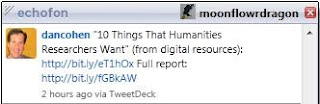
Oh my oh my oh my: just when I thought I might be able to stop and go to bed echofon tells me that Dan Cohen thinks this worth mentioning:
dancohen tweet re RIN report

neat right? but that's not all. While I sniff out the second article (Reinventing research? Information practices in the humanities), RIN go ahead and show me their recent tweets


Did you see? "Mobile use of repositories". MMhm, so Leslie Carr tells me that access of output at University of Southampton ECS repository is "less than 1/4 of the general use of mobile Internet" and he believes this is because pdf doesn't suit small devices. But he mentions "Mekentoshj's Papers and Mendeley for iPhone seem to indicate that an attractive mobile experience should be possible." Ack, and then Richard M Davis replies mentioning his "Download to my Kindle" idea for repositories, and a comment about pre/post publication versions being in "less intricately formatted PDFs" - which makes me wonder, but only a little as I'm more curious about his reference to "Scholarly HTML" which I think might be related to TEI? (Text Encoding Initiative?) but not directly, if I read petermr's hopes for Scholarly HTML correctly.

A question librarians, archivists, repository builders are concerned with is format durability.

That's all very interesting, but I'm guessing it is not one of the biggest issues to anticipate in the near future of collection development at a regional university library?

Sunday, April 03, 2011

Modern Romance and the Malcontent: Survey for my sister.

For a project at TAFE my sister is focussing on modern romance (not the genre - the real life thing), the history of romance (chivalry), what do women and men want in their romantic relationships and a section of how to's or suggestions.

She asks if we will be so kind as to fill out a survey for her.

Modern Romance and the Malcontent
http://www.surveymonkey.com/s/NDQFLT2


Unfortunately, due to the limitations of survey monkey she can't ask more than 10 questions,  so if there is something more you'd like to say on the subject - any opinions you have - then please email her [waterspiritdragon |at| hotmail \dot/ com] with your thoughts; or comment here and I'll pass it on. Hopefully, this survey will give her an idea if her thoughts and feelings in this area are expressed by a wider audience or if she's standing on an opinionated island waving her own little flag.

This survey is for MEN and WOMEN.  She needs an equal number of both.

For this survey to be useful - she needs as many responses as possible.  She's hoping for 1,000+, so please feel free to disseminate the link:

Modern Romance and the Malcontent
http://www.surveymonkey.com/s/NDQFLT2

Projected, recorded, uploaded, embedded

Enjoy the music with me? thanks to Alex Ross and others (see below)?


"The first part of Wagner's "Flying Dutchman" Overture, as played by the New World Symphony under the direction of Michael Tilson Thomas, at the New World Center on Jan. 28, 2011. The image is being projected on a seven-thousand-square-foot wall; the sound is heard over a network of 167 speakers." [Youtube video description]

Or wonder at technology with me?
  • Miami's New World Centre's Wallcast projects concert hall performances outside. (Frank Gehry designed the center, who can we thank for the sound and simulcast tech?)
  • [?unidentified device] captures the cast in excellent quality.
  • YouTube lets Alex Ross upload the recording and me embed it here.
  • Blogging programs like WordPress helps people share stuff online
  • Extra-blogging stuff like tracking back builds conversation
  • Repository software like dSpace helps institutions collect and preserve scholarly writing.
  • Online courses with course managment software... hm, can't really promote the one used for current course as I'm not fond, tend to prefer Moodle.

Or delight in social factors?
  • What explains the expensive projection of performances outside the hall, to the public for free? I can guess why people would use the Soundscape - I want to go!
  • Alex was so impressed (?) he recorded, uploaded, blogged and wrote. AH! to "invite people in" - Alex answers my first question.
  • The beauty of connections: dkl, a scholar interested in "combination of sight and sound in musical experience, and the use of technology to alter their combination", gets caught by Alex's article and later blogs about it. (And dkl "gets" linking in his first post!)
  • Everyone is sharing all this stuff online.

So maybe it is just one factor in different dimensions: People love to share what makes them zing.

Or my story:

In which Charles Sturt University School of Information Studies offer a course by distance (that (if I finish) would qualify me to be a reference librarian), in which John Kennedy, Bob Pymm and Sue Terry authored the Collections subject asking students to explore repository software designer DSpace, who share use case examples including George Mason University's MARS, who preserve blog posts of at least one of their associate professors, Dan Cohen who (among many wonderful contributions to online scholarship) writes and talks inspiringly about the value of the blogging genre for scholarly communication (see why I listened for an hour!?). Dan uses WordPress and his team designed Zotero and and where was I? ... oh yes, Dan's blog captures trackbacks so I noticed dkl's first post at Spooky and the Metronome, where he grabs my attention: music+image, a mix of styles in one post, his personal story, scholarly meditations, and darn him for linking instead of embedding the above video himself.  Because on seeing Alex Ross' uploaded video of the projected performance - musing at the capacity to see and hear without being there or then, I needed to see it all shifted that extra step in time and virtual space, and now I've added the dimension of posting from Australia.

Wednesday, March 23, 2011

thinking about patron-driven acquisition

Course material points to Barbara Fister's "Puzzled by patron-driven acquisition" and then asks what we think.

I think Barbara was having a vent in good blogger style.  Being a vent, some of her points get a bit mingled.

The clearest and most important point she made was
Used as a supplement to traditional collection development (which is already patron-driven, in that we have always tried to match choices to expressed or even inarticulate needs) it makes a certain amount of sense--provided your patrons will use e-books
[my italics]
In fact, what else is there to say?  I'd say that sums up a reasonable point-of-view.

Barbara was concerned about some speakers' enthusiasm for the method of acquisition, although she didn't identify anyone who is using it as their *sole* method of collection building. I can see how people can get enthusiastic - being able to put titles before our patrons before we buy them, being able to offer a loan (at a loan price) and only choose to buy if an item is borrowed a few times and we think it might have continuing value - this sounds wonderful.  Of course how wonderful depends how much it costs us simply for access to the database of ebooks (which I'm not in postion to know), and how well suited the database is to our likely needs (which I'm guessing is tailored to the library's profile) - but the principle is promising.


More frustrating in my course is that the next question presents false dichotomy and does not even follow from the above reading or any prior in the unit: "should librarians choose what they think people should be reading (or viewing or listening to) rather than what they want" as if the answer is not obviously NO in response to the "should" in most cases but also "it depends" because of course it is possible that there is a library somewhere whose collection development is based solely upon a specific curriculum of readings for a specified purpose in a narrowly focussed organisation, and in that unlikely library "what they want" simply wouldn't arise. 

Seriously?
"should"? - is this deception, obfuscation or muddy communication? does the question mean obliged, duty-bound, propriety-bound, expected, could, would or something else?
"rather than"? is such an either/or likely to arise?
"what they want"? a want articulated? like a request?

It is not a real question.  When, if the budget has not run out and the "want" is within the parameters of collection development for the library and patrons are permitted to make a request, would a librarian ever be forced to choose between a valid request and some other collection appropriate item?

Beauty & the Beasts

Saturday, March 19, 2011

Power of social search + Google Image + fortuitous error?

echofon displayed for me a puzzle [RT] from toddtyrtle:


Curious whether I could track it down I wasn't having any luck with a variety of descriptive words, so I skipped to a guess and google image search. My guess was wrong, but luckily it caught an equally half-wrong? description at istockphoto.

BTW do *any* maples have similar seeds?
or is this a case of fortuitous error?
I'd say serendipitous if not for discovering Walpole's original meaning

After Maple the description included "London plane tree". On adding that to the search google brought up a similar query at arboristsite to which Sylvia had suggested a sycamore and linked Virginia Tech's Department of Forest Resources and Environmental Conservation VTreeID Factsheet of American Sycamore.  Great database, with pictures of tree, leaf and seed. In this case, although it is difficult to tell because in andy's pic the seed is exploded, it still looks fluffier than the American, and more like the Arizona Sycamore I think.  Sadly the database itself doesn't seem to include description of seeds, so from it I can't learn how to describe seeds.

Back at Google Image Search I checked other images of London Plane and Sycamore seed photos - and I'm leaning towards Sycamore.

I was impressed with the power of social answer finding (?social search engine) allowed me by Flickr a few years ago, when I uploaded a photo called "what flower is this" and 17 months later (possibly after I added it to a group) was surprised to find an answer but andycaster had his answer in ... 35 minutes?

Sunday, March 13, 2011

What kind of Embodied Cognition can help me produce an essay?

Can someone own up to tweeting about this blogpost by Stephanie Willen Brown: CogSci Librarian: Embodied Cognition?

I read:
"Embodied Cognition...[see Stephanie's post for an explanation if you need it]...article in the January/February issue of Scientific American Mind: Body of Thought by Siri Carpenter...[a couple of examples]:
  • Just in the past few years studies have shown that holding a hot cup of coffee or being in a comfortably heated room warms a person's feelings toward strangers ...
  • [T]hat sitting on a hard chair turns mild-mannered undergraduates into hard-headed negotiators"
 and have been wondering ever since how essay writing powers might be embodied (so I can switch them on).


Blogging towards an essay?

I do find blogpost writing conducive to thinking - although it is frustrating because it takes so long, so maybe there is something in the idea in my last post to work on ideas here - I don't even have to post them, just being in the frame might help.

Downside to that idea is that part of my focus at the Blogger Edit Post screen is to try for a writing style that suits blog-reading (yeah ok I'm not great at that)... whereas my goal for school is an essay.  Some parts of this are a positive.  From what I understand (in theory if not my own practice):
  • In neither case is a long sentence desirable.
  • In both a logical flow of argument is desirable.
  • I'm remembering phrases that probably apply to both, like
    • "show, don't tell" and in both cases link it (though the citation method differs)
    • and "Trim the fat"
  • .... anything else?
Aside from citation methods, and blog=personal .v. essay=impersonal, what distinctions between essays and blogposts should I keep in mind if I work up my essay in a blogpost?